
Hydropower
how concrete shaped the flow of Squirt—and our dreams

This is an excerpt from the book Sadness of Pleasure: Zen and the Art of Squirt by Ayoto Ataraxia, first edition, paperback, published on February 9, 2023.
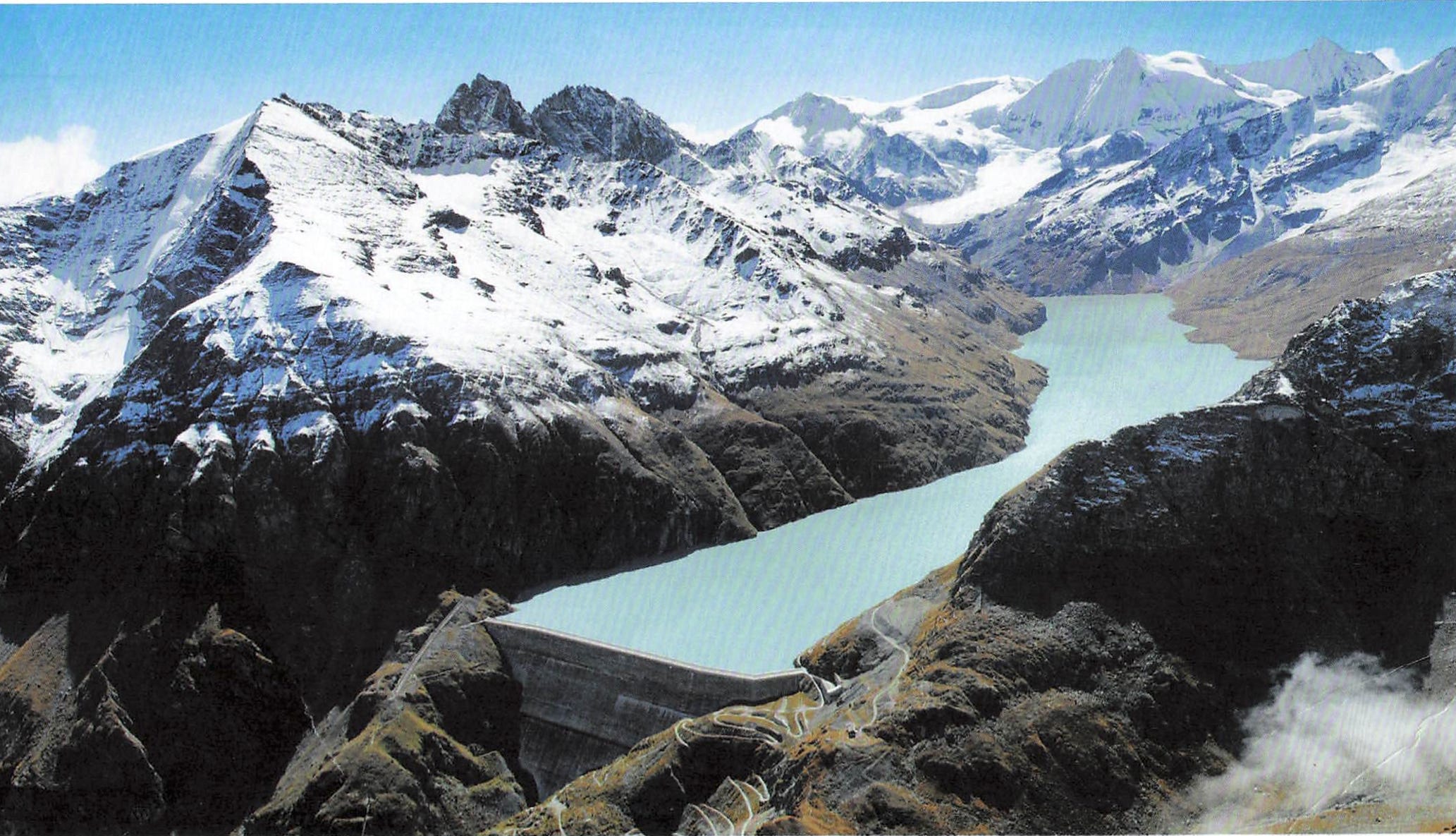
With a new sensitivity to my hydration, I obsess over liquids—my inner flow. My heart pulses, continuously pumping liquids. My body perspires, yearning constantly for replenishment. Liquids ejaculate from my orifices. Droplets form in my tear ducts and nostrils—excretions from my ear canal, anus, urethra and glands. Some people never cry. What tragedy! Large bodies of water appear in my dreams. I turn on the faucet, and crisp, clean water flows from the infinite. As the world climate transforms, water politics becomes ever more obsessive. I recall the construction of the Three Gorges Dam in China. The power it provides, and the displacement of the people downstream. I search for a dam in Europe. The largest is located in Switzerland. The Grande Dixence Dam is the tallest in Europe—the tallest gravity dam in the world.
To reach the Grande Dixence Dam, one must take the windy roads to Hérémence in Switzerland, high above the villages and surrounding lakes and glaciers above everything. The first sight when one arrives is an intimidating looming concrete wall, the crotch between two mountains. I got out of the rental car. I walked up the melting glacier. Holding back all that water, I placed my hand on the looming concrete.
Like any monument, the dam offers tours of its structure. I met Florian, my assigned guide. Since it was off-season, I was the only person on this group tour.
“Not many people know that this is one of the biggest dams in the world,” he tells me. An engineering student. He apologizes for his German accent as he led me into the moist and cavernous world. As he closes the door behind us, I feel the instant wet chill seeping deep into my bones. He reminds me that we’re standing 2,100 meters above sea level as we walk into the damp tunnels. The entire dam is a staggering 285-meter construction, the height of the Eiffel Tower minus its antennas. Despite being the peak of summer, the interior remains at 6ºC (42ºF) all year round.
“The Grande Dixence Dam consists of two dams,” explains Florian, “the first Dixence Dam, which the current dam has drowned, was built before the Second World War. It remains underwater within the Grande Dixence. A gravity dam is a dam that, through its sheer weight, can hold back all the water behind it. The dam itself does not require to be fixed to anything.”
Just through sheer weight, I thought to myself.
”As a comparison,” Florian continues, “the first Dixence dam was an arch dam, so the pressure of the water pushes the weight into the mountains on either side. But the Grand Dixence Dam does not require this shape. After the Second World War, the electricity demand increased in Switzerland, and the first dam no longer provided sufficient power for her people. Three thousand workers and 1 million Swiss francs were required to build this new dam. There was no time to transport the workers back home, as they worked 24 hours daily. Housing was created for the duration of the construction. The workers referred to the lodging as the Ritz Hotel euphemistically.”
I learned from Florian that to produce concrete, one needs stones, cement, and water. The stones were sourced locally, whereas the cement was mined from Sion. Six million cubic meters of concrete were required to build the dam.
The Grand Dixence Dam collects water from thirty-five surrounding glaciers. Hundreds of tunnels and pipes feed into the dam within these Swiss Alps. Without additional assistance, only a quarter of the dam can be filled. The remaining three quarters are brought in from elsewhere. However, most glaciers have a lower altitude than the dam itself. The water needs to be pumped higher than the dam. To alleviate that, five pumping stations were constructed. They pump the water at night when the electricity source is cheap and abundant. The water released from the dam is then transformed into electricity by four separate power stations.
To empty the entire dam at once would require two thousand hours or three months of constant release.
”But with this new pipe,” Florian shares with enthusiasm, “it can now be reduced to one thousand hours, which is only a month and a half.”
“Where does this water go? Surely not just out front?” I ask.
“Absolutely not! The water exits through pipes, which are connected to the power plants. There are no safety valves to send the water any other way. If there were any openings from the dam itself, the pressure would be so high that it would destroy everything in its path.”
“Why would you ever want to empty the dam?”
“If there is a problem with the pressure. But we would never want to empty it completely,” he says.
The dam only requires three minutes to open the valve, or two hundred seconds, to be precise. Therefore, like a switch, it is possible to turn it on and produce a steady source of electricity within two hundred seconds. It requires only ten minutes to stop the water flow and terminate the power production. This is the difference compared to other forms of power generation, such as coal or nuclear, which produce the same quantity of electricity all year round. One cannot simply switch on or off their power production.
“As a society, we are able to create abundant electricity,” says Florian. “However, the difficulty is finding a way to store the power. We do not have the ability to store this much energy, which we are currently creating. If it is not used, it is wasted. With the hydro dam, however, we can, in effect, store that power within the water and release it precisely at the desired moment. The dam, therefore, is a giant power battery.”
Stored liquid of immense power. I wondered why, if hydroelectricity is so great, we cannot depend purely on it. He tells me that it is impossible.
“One-third of the energy is needed to pump the water in the first place. Hydropower isn’t just pure free energy. That power needs to come from elsewhere. It could theoretically depend on solar or wind, but we don’t have enough at the moment,” he says.
The dam consists of sixteen cubic meters of concrete blocks. Within the construction are thirty-two kilometers of tunnels: sixteen horizontal and sixteen vertical. The tunnels are used by barragiste, who enters the dam to study the decay of the concrete. It is necessary to study the moist structure as no one knows how it will age.
Hidden deep within the dam is a giant pendulum with a bob weighing 150 kilograms. This long pendulum is left swaying on a thin rope. Its movements are measured as it sways back and forward, rocked by the concrete dam. Annually, the large structure sways eleven centimeters due to the build-up of pressure behind it.
In 1954, a 24-year-old filmmaker by the name of Jean-Luc Godard was commissioned to document the construction of the dam. Images of men moving rocks and laying concrete to construct this pressurized liquid battery. During that same time, a poet named Pierrette Micheloud wrote eight poems. She was against the construction of the dam. She would recite her poems around the villages to whoever would listen. Her poetry spoke of the land, love, impending barriers, and enclosures.
In 1963, one of the world's tallest dams, at 262 meters, the Vajont Dam in northern Italy, was filled with water. Due to miscalculations, a landslide caused a megatsunami in which 50 million cubic meters of water overtopped the dam, creating a 250-meter wave. It obliterated the Piave Valley and its village below. The dam remained intact, with two-thirds of the water remaining behind it. The dam was largely undamaged, though the power and instability of the landmass surrounding it became too unpredictable to be in use.
How will we interact and extract the energy sources of the future? We may be witnessing the decline of raw human potential, as much of it is slowly being replaced by the restless machine. Will artificial intelligence bypass human output with a more steady and continuous stream of computational superiority? Have we witnessed Peak Sex Power as we extracted every last drop of humanity to exhaustion through the dance of sexual repression and capitalism? How will our society be understood in comparison?
It is exciting to document new constructs and conquests: the changing world and the flowing of liquids. But who will be the Pierrette Michelouds to write the prose for tomorrow when the memories are forgotten?
Join me, Stefanie Rinke and Tobias Weiland for a thought-provoking exploration of Sadness of Pleasure: Zen and the Art of Squirt. Together, we’ll challenge boundaries and delve into the fluid intersections of desire, power, and cultural meaning.
📅 Wednedsay, December 18, 2024
🕢 19:30
📍 IKSK (Institut für Körperforschung und Sexuelle Kultur)
(Holzmarkt 25, Haus 2, 4th Floor, 10243 Berlin)
The event will be held in English and German. Admission is donation-based, starting at €10.