
Please pick up your trash.
Or somebody else will have to.

I stayed in Kyoto for a month with a dear friend by 鴨川 (the Kamo River). There, crisp water runs through. It reminds me of the rivers that my parents spoke about in their childhood. A world that they remember prior to the cost of industrialization. They speak about a world not so long ago, where you could see through the streams, and fish would swim. Now, the river reeks of chemical waste and pollution. But in Kyoto, the Kamo River runs clearly today. By the Sanjo Ohashi Bridge, rowdy young Gaijin’s drink at that junction every night. And every morning, some still stumbling around, trash reveals their passing. Right at that spot is a sign. Elsewhere in the world, signs urging people against littering are in the form of prohibition, together with a threat of punishment, a fine. But this sign was different. It read something along the lines of, “Please pick up your trash after yourself. Because if you don’t, somebody else will have to.”
This sign did something to me. I felt a sense of responsibility. I noticed that every morning, old locals would come and pick up the trash, and by midday, they would all be gone. Pretty soon, I found myself doing the same thing. I’d pick up one or two cans here and there during my morning strolls. Gentle waves of memory nudge this realization onto my conscious shore.
I was out for lunch with a friend last week. The topic of Palestine came up. He spoke of his guilt, only to be erased by defense mechanisms. He added, “…but you know, the protestors are kind of irritating, anyway.”
Irritating. Annoying. Disruptive.
What do you call an agreeable, palatable, constructive protest? A picnic.
In 1963, Vietnamese Buddhist monk Thích Quảng Đức burned himself to protest the persecution of Buddhists by the then-Roman Catholic leader of the Republic of Vietnam. Thích Quảng Đức wrote to Martin Luther King Jr, “The self-burning of Vietnamese Buddhist monks in 1963 is somehow difficult for the Western Christian conscience to understand. The Press spoke then of suicide, but in essence, it is not. It is not even a protest…to burn oneself by fire is to prove that what one is saying is of the utmost importance...There is nothing more painful than burning oneself. To say something while experiencing this kind of pain is to say it with the utmost courage, frankness, determination and sincerity…the monk believes he is practicing the doctrine of the highest compassion by sacrificing himself in order to call the attention of, and to seek help from, the people of the world.”(Hanh, 1965)1
What do we commit ourselves to in our society? Neoliberalism pushes for noncommitment. Contactless ensures the flow of capital does not rest. But what does that say about ourselves? People committed to a marriage. To God. To something beyond themselves. Religion is said to be a lightning conductor that helps ground and guard us from thunderous narcissism.
“Committed” is derived from the Latin word committō, which describes a state of being dedicated, devoted, or bound to an idea, a cause or an activity. It often implies a pledge or an obligation that has been undertaken. One can also be committed to a mental asylum. Who do we deem in need of “commitment” for treatment?
Today, if one is too committed to anything, one is considered “radical” or “obsessive.” Question is, what do you give yourself into? What do you commit to?
“You know, I see you as an activist. You’re no longer an artist; you’re an activist,” he said. I grimaced at the thought. What global event is required for people to stop what they’re doing and demand changes? What does it take for someone to care? What level of terror obligates a person to commit to change?
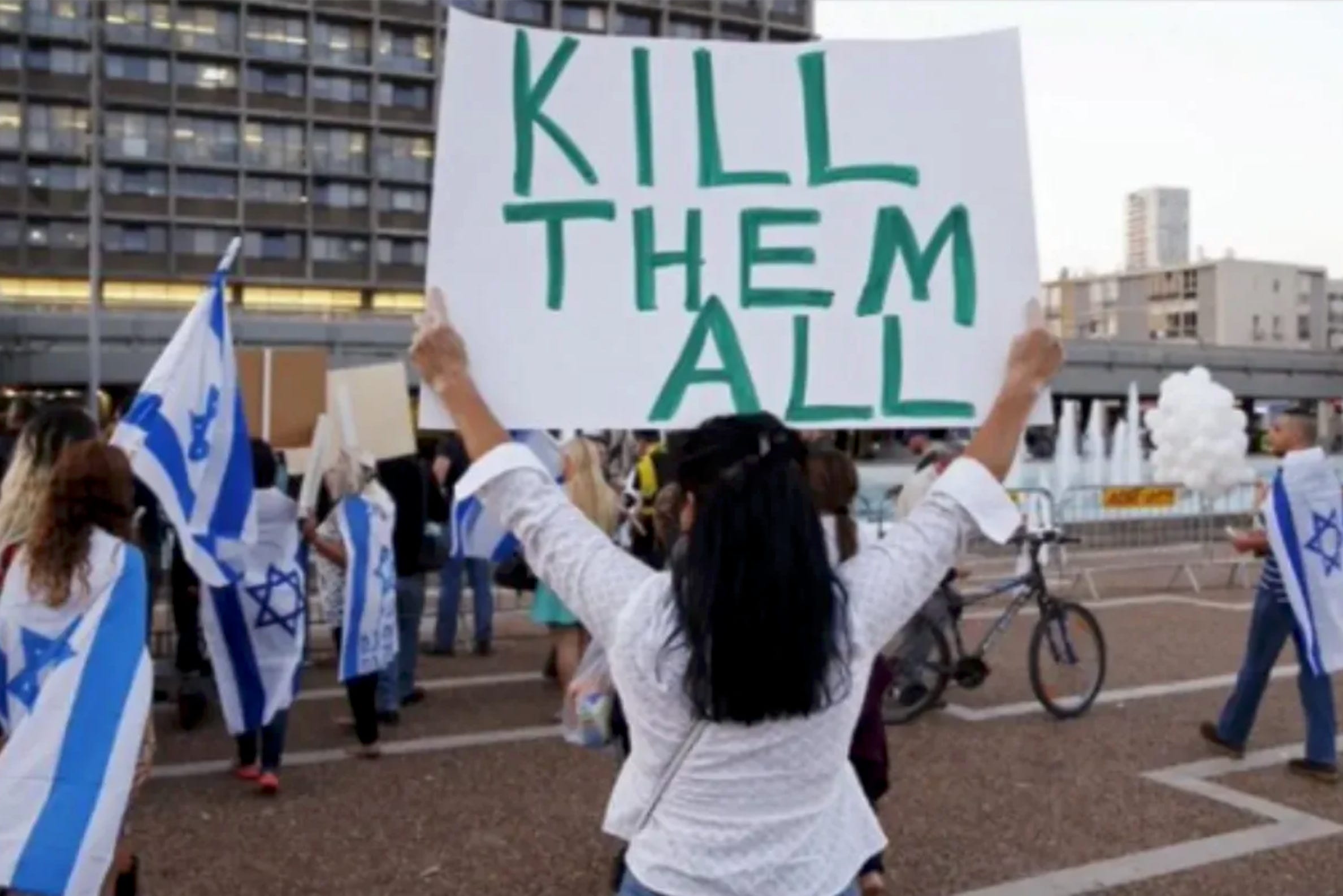
An image appears on the scroll device, Zionists, wearing the Israeli flag like capes, a woman holds a large sign: “KILL THEM ALL.”
What does she commit to? Simultaneously, those speaking for Palestinians are accused of anti-semitism, hatred and genocidal intent. Another Zionist spoke about her excitement for the land development that is to come in Gaza, where they shall demolish everything and erect a Disneyland, Starbucks and malls. What kind of commitment is this?
So I return to my friend, who is split between feelings of guilt for his non-participation and his non-commitment, but to what precisely? What is on the other side of the non-commitment? In Berlin, there is a large community of artists. But what precisely are we art-ing? What is art? What is music? What is a society that has no moral compass or commitment?
I think back to the Kamo River and the old people every morning, picking up after the youngsters. “Please pick up your trash. Otherwise, someone else will have to,” transfers just as easily to, “Please speak and fight for what’s right. Otherwise, someone else will have to.”
On February 25th, 2024, Aaron Bushnell, a 25-year-old serviceman of the United States Air Force, approached the Embassy of Israel in Washington, D.C., and committed an act of self-immolation at the front gate to protest United States support for Israel’s genocide.
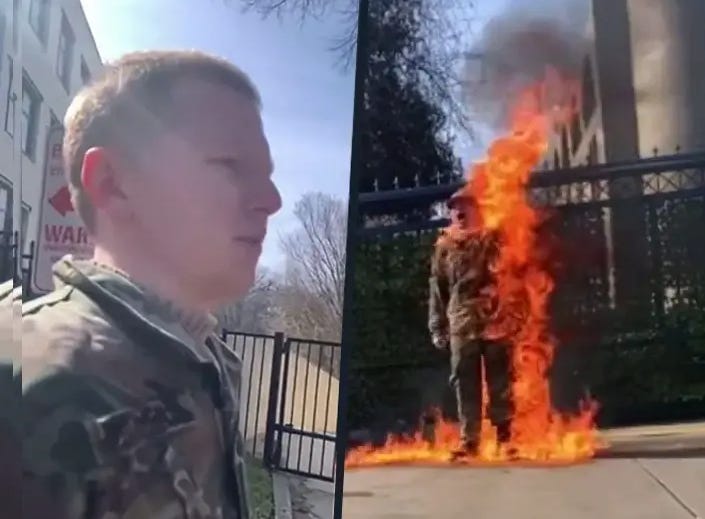
In the video, after Bushnell is on the ground and the fire has been burning for what feels like an eternity, a police officer points his gun relentlessly at Bushnell. Even in this moment, the officer is compelled by the only thing he knows: violence through force. A man dies to make his final statement, and he can only think with his gun. But how will he shoot his way out of his nightmares? The gun and its phallus-centric society. But this is a fantasy. Behind the rockets, the bombs, and the power is the biggest reveal of impotence. It is in the lack that one desires most.
During the Warring States Period (481/403 BCE - 221 BCE) (戰國時代), 屈原 (Qu Yuan) served the state of 楚 (Chu) as a loyal minister. He was vocal against the political complacency and corruption amongst his peers and the choices made by the emperor. He warned against the encroaching power of 秦 (Qin), but his commitment to the future of his nation led to the banishment of his position in the court. He was devastated by the decision of the emperor and the direction that his people were headed. He ultimately took his own life by tying himself to a stone and throwing himself over the bridge and into the 汨羅江 (Miluo River). (Interesting parallel is that as Israel blocks aid trucks, turns off the water, Palestinians tie stones to their stomach to get through the hunger pains of the night. Those who have larger bodies are told to tie multiple stones. The tightness is said to cover the pain.)
Qu Yuan’s despair for his homeland sparked an outpour of grief and respect from the populace. Two and a half millenias later, his forsight and commitment is memorialized through the Dragon Boat Festival and 粽子 (Zongzi).
What are the lessons of Qu Yuan’s commitments? Empires come and go. Disruptions are decisive.
Qu Yuan left us his works of poetry, one of which is 離騷 (Li Sao, translates roughly to Encountering Sorrow).
身既死兮神以靈,
壤則厚兮魂以薄。
陽鳥罷兮不能鳴,
啾啾鳴兮求其友。

Though my body dies, my spirit will be ethereal,
The earth will be thick for me, and my soul slight.
The sunbird is exhausted and cannot sing,
Chirping and chirping, it seeks its companion.
—
Comparatively, contemporary Palestinian Poet مروان مخول Marwan Makhoul wrote:
In order for me to write poetry that isn’t political
I must listen to the birds
and in order to hear the birds
the warplanes must be silent.
—
What is the function of art if all you decorate is the empire’s propaganda (Levine, 2020)?2 What is the point of music if it only serves as an instrument of torturing alienation (McKinney, 2014)?3 Acts of monstrosity require a severance of humanity. If we don’t dare to feel, someone else will have to take on twice the burden.
What values are you committed to?
Back at lunch with my friend, the violence of genocide is never far from my thoughts and conversations. Is it out of concern, care, fear or an obsessive Tourette’s need to say what cannot be said? On the surface, so many well-meaning, nice whites try to reassure themselves of the values of humanism, democracy and dignity. But of course, there’s a time and place to discuss issues, and some should never be inappropriately brought up. /sarcasm
If not now, then when?
“But hey, you know that Instagram and social media are just designed to pit us against one another?” he said. Is this a deterrence to change the subject? “Anyway, much of the pro-Palestinians gets kind of annoying,” he quipped, the way which isn’t insulting, just matter-of-factly.
If not here, then where?
“Also, social media isn’t real,”
As another aging millennial, of course, I know that social media isn’t real. But on a timeline, where the only way to access the immediecy of the terrors that is occuring in Gaza is through Instagram. While out in the free and democratic societies, the wind of silence sweeps over our interactions. Are IRL interactions more real? What was it like to live through not just Nazi Germany but complacent Europe as the Jews screamed in the camps? What was it like to live through the Antebellum South, as whites send lynching postcards to one another?
If not me, then who?
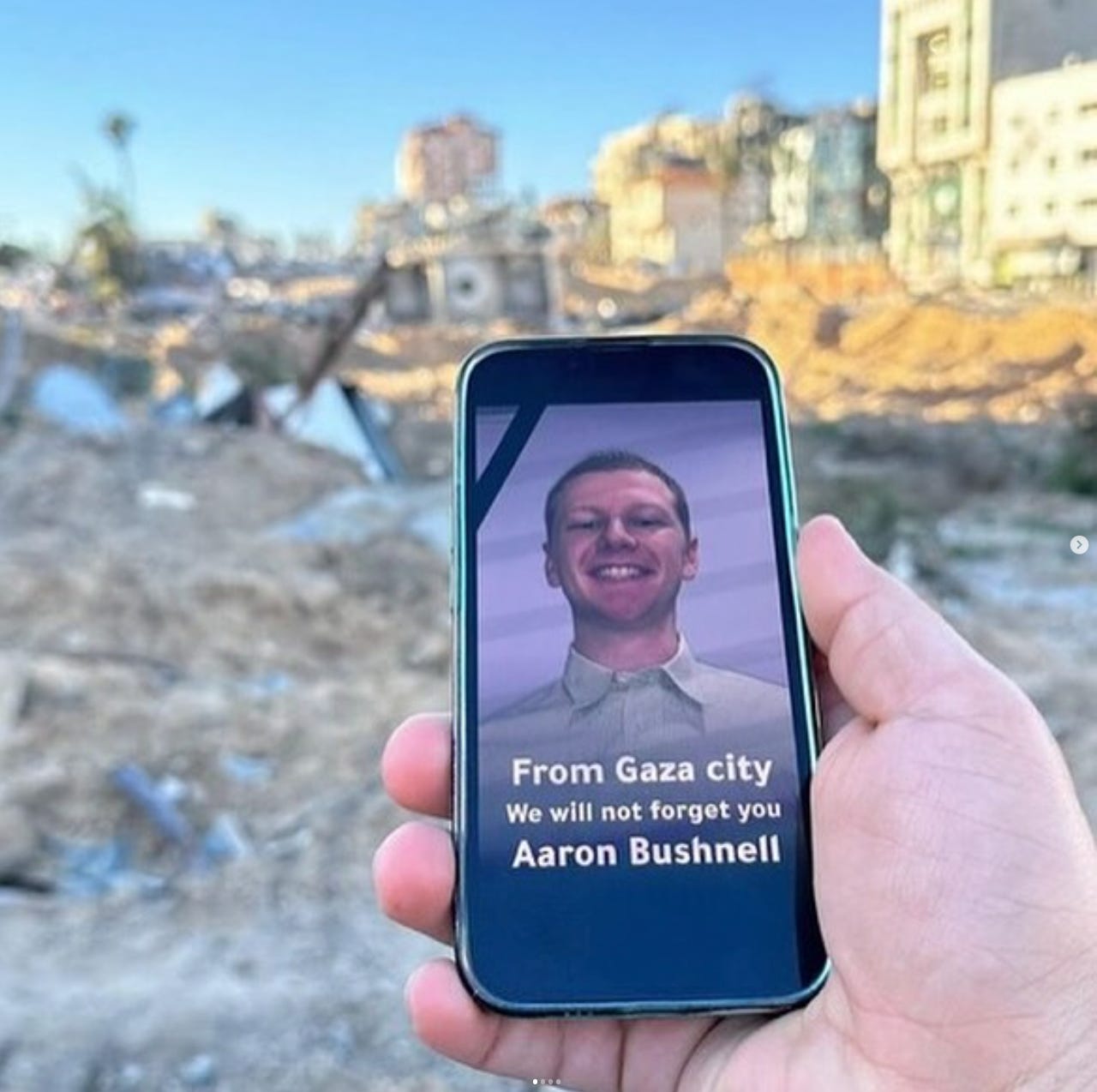
Aaron Bushnell’s last words in front of the embassy were,
“I am an active duty member of the United States Air Force. And I will no longer be complicit to genocide. I am about to engage in an extreme act of protest. But compared to what people have been experiencing in Palestine at the hands of their colonizers—it's not extreme at all. This is what our ruling class has decided will be normal.”
In Gaza today, Palestinians carry the picture of Aaron Bushnell, saluting his courage and promising not ever to forget him. Is the photo of Bushnell real? It is as real as a travel saint dashboard ornament. The question isn’t what is real or tangible, but what intangible values do we commit to? Like our first games of peekaboo, we must learn that just because we close our eyes, reality does not disappear.
Thich Nhat Hanh. (1965). Dialogue. Vietnam: La Boi Press.
Levine, L. (2020, April 1). Was Modern Art Really a CIA Psy-Op? JSTOR Daily. https://daily.jstor.org/was-modern-art-really-a-cia-psy-op/
McKinney, K. (2014, December 11). How the CIA used music to "break" detainees. Vox. https://www.vox.com/2014/12/11/7375961/cia-torture-music
I can feel my heart breaking as I read this. I wrote a whole dissertation on the topic of commitment and oppression. After some personal experiences.
It’s the white patriarchal capitalist mindset of personal gain rather than mutual gift. Biggest bang for buck, return on investment…we have no commitment because we have no skin in the game.
We’ve ecologically removed our skin and bodies - literally - from the game through clothing, air con, buildings. We have made life more stable, predictable, taken away danger of starvation (processed food) or predation (endangerment of many predator species).
We’ve relationally removed our skin in the game through the marketplace of online dating, the commodification of relationships, the objectification of potential partners. Don’t like this one? Go to the store and get a full refund!
To commit is to have skin in the game. It is to take on risk. It is to be invested, to care, to need, to give a damn. Hetero-patriarchal western culture as well as New Age stuff demands we all be “chill.” Don’t care too much. Don’t show your cards. Don’t depend or have anyone depend on you. Relax. Stop being hysterical. Think positive thoughts. Go with the flow. “Just let go.”
To be alive is to risk. It is to be vulnerable. To risk loss. To hurt. The robots, AI and techno-utopians promise us a world where we never have to risk but…it’s a lie. We are always at the whims of nature and the elements, the finance system could collapse any moment with its $200 quadrillion in derivatives (?!), earthquakes could destroy my flat in an instant.
One another is all we have.
The discomfort you describe here of people really committing to standing up for Palestine reminds me of how my parents conditioned us to not look at beggars when we lived in India. Even to look so dangerous. To give is dangerous. If you give to one, then you must give to all, give forever, and you’ll have nothing left. You’ll become a beggar yourself. Don’t become dependent; don’t let anyone depend on you. Stand on your own two feet. Inside your flesh encapsulated in skin. Alone.
The “pick up the trash” part also made me cry. How beautiful to see that sign and to see people care and do something about it. I just feel so heartbroken about how much rubbish and pollution there is in India and how overwhelming it feels. I just watched a clip of Julia Butterfly Hill living continuously on a platform high up in the redwood trees for over two years to stop thousands of year old trees being bulldozed - getting supplies sent up to her by rope etc. So amazing.
I can understand it’s hard to commit to anything in a world that feels so uncommitted to us. Why should I commit to this job, this electricity company, this place…when capitalism doesn’t care and nobody has time to commit to anything or anyone beyond perhaps their nuclear family and work? Everything feels fragile. Finance, relationships, jobs, family, health. No one seems to care, not enough, not consistently. Why should anyone persist and show up and commit? The world has moved on from “boring” values of stability, steadfastness, predictability, solidity, and it’s all about novelty (eg academia), innovation, the “spark,” the X factor.
It’s not worth making it work out, doing accountability, because you can just walk away without consequences and find another job / partner / family / friend group / hobby / therapist / etc. And that’s great…because some jobs and some places really do suck. But also not great - we have everything at our fingertips and nothing at all, all at the same time.
From being an artist that loved spontaneity, exploration, adventure, I’ve gone through a kind of hell and found myself craving routine, predictability, constancy. Nice quiet boring values. Friends who commit. Jobs that are stable. Flats that I can stay in long term. And getting my skin - literally - in the game by via sunshine and ice baths. We’ve forgotten how to connect because we’ve forgotten how to be exposed, literally. And to be exposed is to touch and be touched - by sunshine, cold air, rain, earth. The more I follow the cycles of light/dark, and get exposure to the elements, the better I feel. Paradoxically more “invulnerable,” but that is a topic for another day.
The last thing I wanted to say: Interdependence constrains power. For those who want power, dependence is to be eliminated.
The more we depend on others…the more we rely on them for getting our needs met, the more likely we are to do things that will also make their lives more wonderful. And conversely, the less committed you are in a relationship, the less you care, the less you’re bothered by someone meeting/not meeting your needs…and the less inclined you feel to meet theirs. This is called the “principle of least interest” in the literature. Like when you’re haggling in India and you have to pretend not to care about the item you actually really do want to get the lowest price. Capitalism makes everyone want the lowest price. To be the least invested.
The more we live in a society which is all about the Story of Separation, about the denial of dependency, the less committed we are. When everything appears as a homogenous class of interchangeable, fungible entities, there’s no need for dependence on *this* forest, on this river, on this human, on this community. It’s about an objective, homogenous, abstracted “other,” rather than about a unique individual bound to the self by particular ties. The system convinces us that bonds of connection are really bonds of slavery, while enslaving us in its delusion of freedom.
A freedom that is SO good for us that we need bombs, guns, coups, assassinations and genocides to enforce it.
Excellent piece, and thank you 🙏🏾
wow ❤️